Dainton's Journal
PPF vs Ceramic Coating: Which Does Your Car Actually Need?
6 min read · 19 June 2026
PPF physically shields your paint from stone chips and scratches. Ceramic coating chemically bonds to your paint to add gloss and repel water. They do completely different jobs — which is why the best protection combines both. If you can only choose one: PPF if you drive on motorways or fast roads; ceramic coating if your car stays garaged or is rarely driven.
Every week, customers call us asking some version of the same question: "I've got a new [BMW / Tesla / Porsche] and I want to protect it. Should I get PPF or ceramic coating?"
The honest answer is: it depends on what you're actually worried about. Not in a vague "it depends" way — in a specific way that, once you understand, makes the decision obvious.
We've applied both products to thousands of vehicles from our studios in Reading over the past 12 years. Here's what we've learned.
What PPF actually does
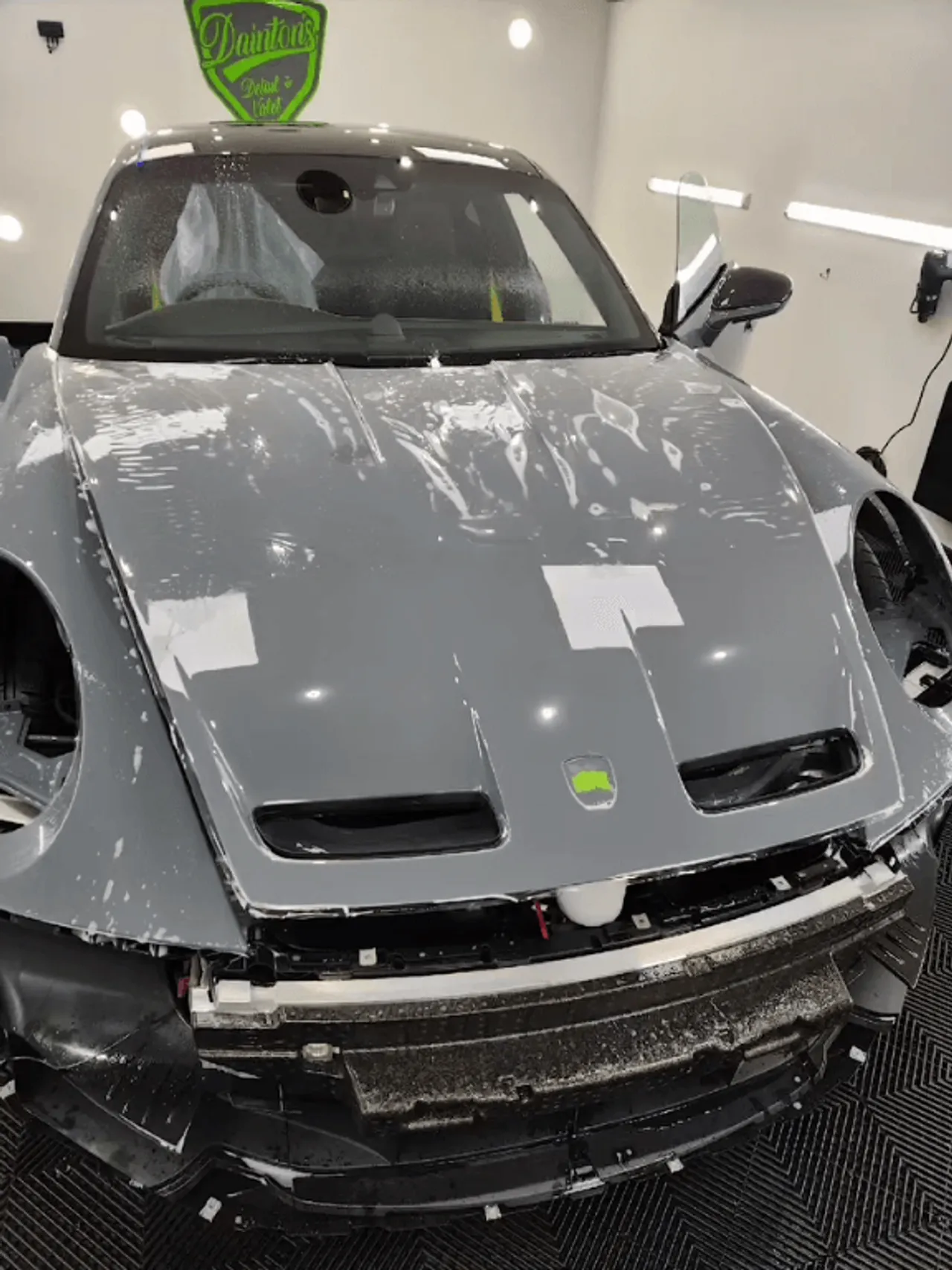
Paint protection film (PPF) is a physical, self-healing polyurethane film that is precision-cut and applied directly to your vehicle's painted surfaces. It is typically 6–8 thousandths of an inch thick — invisible to most people, but substantial enough to absorb stone chip impacts, minor scratches, and road debris that would otherwise scar your paint.
The key word is physical. PPF is a layer of material sitting between the outside world and your paintwork. When a stone flies off the motorway and hits your bonnet at 70mph, the PPF takes the hit. Without it, your paint takes it.
Modern PPF also has a self-healing top coat. Heat — from sunlight or a warm water wash — causes the film's surface to flow back into shape, erasing light scratches and swirl marks. It is genuinely remarkable technology, originally developed for military helicopter rotor blades.
We install SunTek PPF exclusively. It carries a 10-year manufacturer warranty against yellowing, cracking, peeling, and staining. In our experience, films installed correctly will outlast that warranty without issue.
What ceramic coating actually does
Ceramic coating is a liquid polymer that chemically bonds to your paint at a molecular level, creating a semi-permanent protective layer. Once cured, it is significantly harder than conventional wax or paint sealant.
What it does: makes your paint hydrophobic (water beads and rolls off), easier to clean, more resistant to UV fading, chemical etching, and light contamination. It also enhances gloss depth, often dramatically.
What it does not do: stop stone chips. Ceramic coating is measured in microns — it adds hardness but no meaningful thickness. A stone chip travelling at motorway speed will pass straight through a ceramic coating as if it were not there. Anyone who tells you otherwise is either misinformed or selling you something.
At Dainton's we apply coatings from Gtechniq and CarPro. Our top-tier Gtechniq Crystal Serum Ultra carries a 9-year guarantee and is one of the most durable coatings commercially available.
Head-to-head comparison
| Factor | PPF | Ceramic Coating |
|---|---|---|
| Stone chip protection | Yes — absorbs physical impacts | No — too thin to stop chips |
| Scratch resistance | High — self-healing surface | Light — resists light marring only |
| Gloss enhancement | Maintains factory gloss | Yes — significant depth increase |
| Hydrophobic (water beading) | Some — depends on film | Yes — strong beading effect |
| UV protection | Yes — blocks UV rays | Yes — some UV resistance |
| Ease of cleaning | Easier than bare paint | Much easier — dirt releases easily |
| Starting price (Reading) | From £1,200 (partial wrap) | From £295 (Entry Shield) |
| Longevity | 7–10+ years (10-yr warranty) | 1–9 years (grade dependent) |
| Installation time | 1–5 days | 1–2 days |
| Reversible | Yes — professionally removed cleanly | No — chemically bonded |
Which one is right for your situation?
Choose PPF if:
- You regularly drive on motorways or A-roads where stone chips are common
- You have a new or high-value vehicle and want to preserve the paintwork long-term
- You are planning to sell or return the vehicle and want factory-condition paint
- You have a leased vehicle and want to avoid end-of-contract damage charges
- You drive a prestige or exotic car where a single respray panel could cost £3,000+
Choose ceramic coating if:
- Your car is garaged or driven rarely — stone chip risk is lower
- You want significantly easier maintenance and a wet-look gloss finish
- You have an older vehicle that has already accumulated minor chips
- You want a cost-effective layer of protection without the PPF investment
- You have already had PPF installed and want to maximise its performance
"The most common mistake we see is people choosing ceramic coating because it's less expensive, then being disappointed when their bonnet still chips on the M4. PPF and ceramic coating are not competing products. One stops physical damage; the other makes your car easier to look after."
— Chris Dainton, Founder
Why the best answer is usually: both
The most popular choice we see at Dainton's — particularly on new cars, Teslas, Porsches, and prestige vehicles — is a combination of PPF and ceramic coating applied on top.
Here is why this works so well:
- PPF covers the high-risk panels — typically the full front (bonnet, bumper, wings, mirrors, headlights) where 80% of stone chip damage occurs
- Ceramic coating goes over the PPF and across all remaining panels, adding hydrophobic properties, enhanced gloss, and easier maintenance to the entire vehicle
- The result: complete stone chip protection on the panels that matter, with the whole car easier to clean and looking better than factory
This combination also extends the life of the PPF. The ceramic coating's hydrophobic surface prevents contaminants from bonding to the film, which means less cleaning effort and less risk of micro-scratches during washing.
What about the cost?
PPF costs more than ceramic coating, and there are straightforward reasons for this. The film itself is a manufactured product. Installation requires cutting the film to precise patterns for each vehicle model and applying it by hand — a full vehicle wrap typically takes three to five days. You are paying for a physical product plus significant skilled labour time.
Ceramic coating is a chemical application. The material cost is lower, and installation takes one to two days. The price reflects this.
At Dainton's, our prices are:
- PPF partial wrap (front bumper, bonnet, wings, mirrors): from £1,200
- PPF full vehicle wrap: from £3,500
- Ceramic coating Entry Shield (1-year): from £295
- Ceramic coating Pro Guard (3-year): from £450
- Ceramic coating Ultimate Armour (Gtechniq Crystal Serum Ultra, 9-year guarantee): price on application
Think of it this way: if your car develops a stone chip on an unprotected front wing, a colour-matched respray on a single panel can cost £400–800 at a body shop. A partial PPF wrap is less than three panel resprays. On a new car, most owners will chip the front three times in the first two years without PPF. The maths works out quickly.
Not sure what your specific car needs? We'll look at your vehicle, your driving habits, and your budget, then give you a straight recommendation.
Get a Free Recommendation Call 0118 359 2229Frequently asked questions
Can you apply ceramic coating over PPF?
Yes, and we recommend it. Ceramic coating over PPF gives the film a hydrophobic surface that makes it easier to clean and helps it maintain clarity long-term. This is the combination we use for most of our premium protection packages.
Does ceramic coating prevent stone chips?
No. Ceramic coating adds hardness to resist light surface marring (the kind caused by improper washing), but it is not thick enough to stop stone chip impacts. If stone chip prevention is your goal, PPF is the only real answer.
How long does PPF last compared to ceramic coating?
SunTek PPF carries a 10-year manufacturer warranty and will typically last that full term with proper care. Ceramic coating longevity depends on the grade: our Entry Shield lasts around 1 year, Pro Guard around 3 years, and Gtechniq Crystal Serum Ultra carries a full 9-year guarantee. PPF generally outlasts all ceramic coating grades as a physical product.
Should I get paint correction before PPF or ceramic coating?
Yes — for both. Any imperfections present in your paint will be locked in permanently once PPF is applied, and amplified by ceramic coating's high gloss. Paint correction before either treatment ensures you are sealing in perfect paintwork, not imperfect paintwork. We include a preparation stage in all our protection packages.
Is PPF reversible?
Yes. SunTek PPF is designed to be professionally removed cleanly, leaving the original paintwork in the same condition it was in at the time of application. This makes it particularly valuable for leased vehicles — the film comes off cleanly at the end of the contract, avoiding damage charges.
How do I find the right installer?
Look for a SunTek or XPEL certified installer. Certification requires training and ongoing quality standards. Many PPF installations fail not because of the film but because of poor installation — bubbles, lifting edges, and peeling are signs of rushed or undertrained work. Our SunTek certification means we are trained and regularly audited on installation quality.
Explore Our Services
Paint Protection Film
SunTek-certified PPF installation. Partial wraps from £1,200, full vehicle from £3,500.
Ceramic Coating
Entry Shield from £295. Gtechniq Crystal Serum Ultra with 9-year guarantee available.
Paint Correction
Single to multi-stage machine polishing to restore your paintwork before any protection.
Not Sure What Your Car Needs?
Tell us about your vehicle and how you use it. We'll recommend the right treatment — no hard sell, no jargon.